Embracing Seasons and Cycles and Becoming More Myself
While watering my plants this week, I spotted flowers forming on some of my begonias. My little lemon tree is putting out buds and new growth and the lime has been flowering for a while (which reminds me, I need to grab a paint brush and pretend to be a bee).
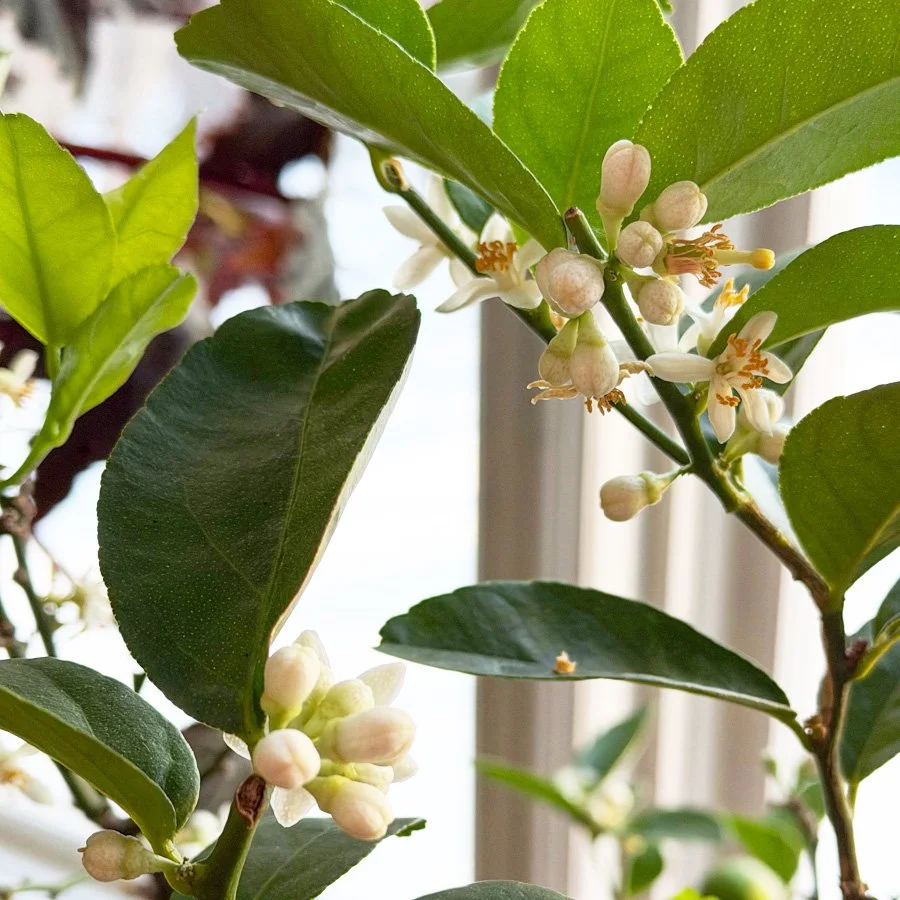
My lipstick plants, including the tiny rooted cutting from my mom, are filled with flowers. Although yesterday morning it was -23° F (-31° C) with a windchill of -43° F (almost the same in Celsius) and today was -17° F (-27° C), spring really is on its way. The plants know.
About a year and a half ago, I was feeling burned out and creatively stuck. I sat down to write a blog post and felt as if I had nothing left to say. I write (and paint) the same things over and over and over. As a botanical artist and gardener, my creative life is shaped by the seasons. Each year I grow my garden and paint from its inspiration, working from plants and flowers cut and brought into my studio for reference. Each winter I turn my attention to my houseplants before beginning my outdoor garden again. It’s a process and a cycle that I cherish, but at the time it felt repetitive and stifling. A sign of my burnout and a need for deep rest.
I recently finished paintings of two poinsettia plants. Over the years, poinsettias have inspired me again and again. As I was finishing these two new paintings, I hung three older paintings on the wall behind my table. It felt good to see all these pieces all side by side. The old, the new, the progression of my skills and my style. I remember working on each painting. The spark of inspiration. The joy of studying the plants, of mixing colors, of watching paint blend on the page, of adding the finishing details that transform a piece from messy middle to finished painting. This repetition was beautiful.
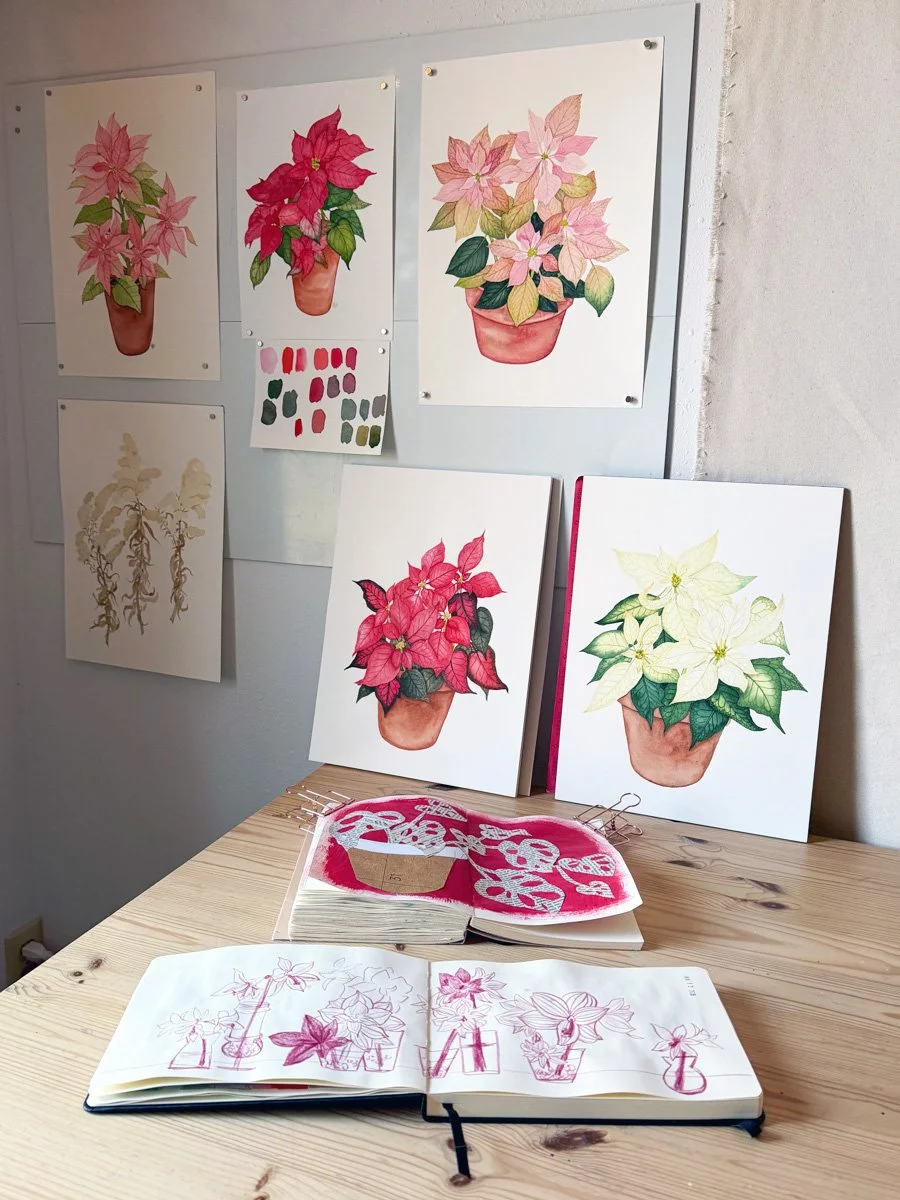
I’m done with poinsettias for now (until I start designing next year’s calendar, which will undoubtedly include one of these new paintings as the December illustration) and I’m currently tackling another watercolor project, but I can’t help dreaming about what other houseplants I’ll paint in the coming months. Last winter I was on a roll, as is evidenced in this year’s calendar; five months are illustrated with houseplants.
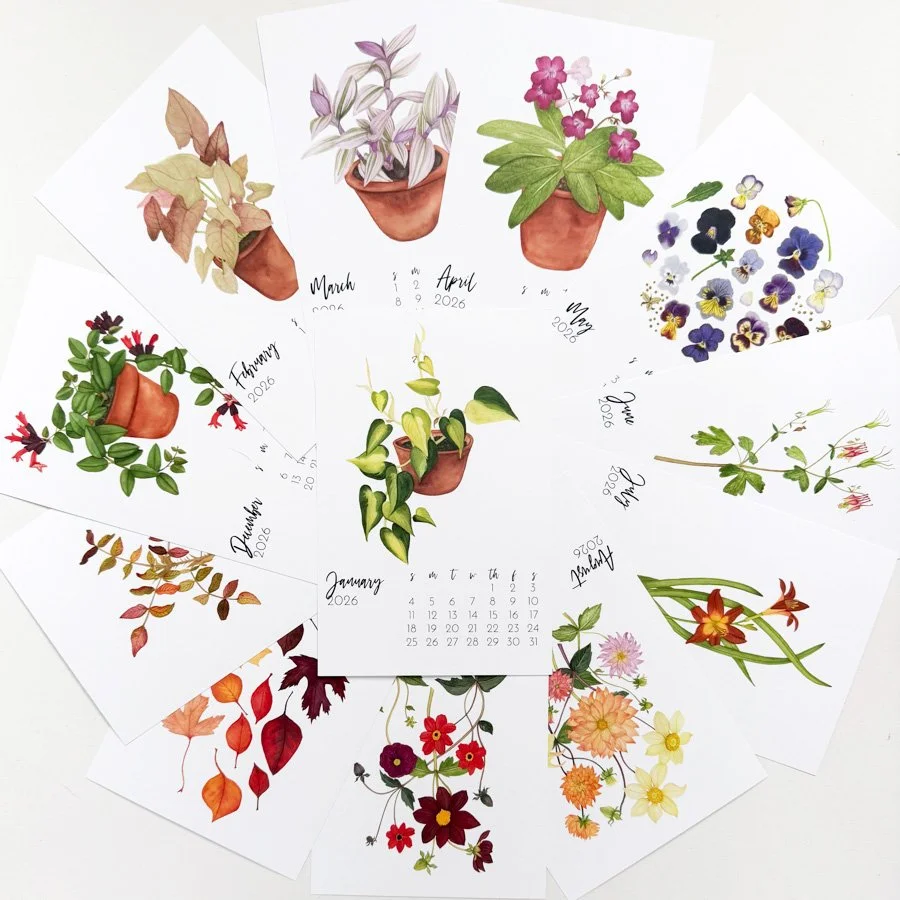
Each calendar year is a cycle, month to month, season to season. There’s comfort in knowing spring follows winter and summer follows spring, that nature shifts and changes and shifts and changes again. There’s comfort in acknowledging our own seasons and cycles and the way in which we shift and change, too.
Beginning a new year always makes me feel contemplative. I’m always curious about what captures my attention – not just in my art and creative projects, but in my thoughts, what I write in my blog and on the pages of my journals. How I spend my days.
This year I’ve been thinking a lot about being present in the real world. The Analog Life Project’s enthusiastic reception points to how so many of us are craving a change in focus. I stumbled upon my journal entries from last year when overwhelm and burnout were slipping in again and I filled pages with rants against the constant distractions of online life. Reading those words, I realized I feel much more comfortable now. Looking back, I can see my shift in focus from online to analog didn’t just start this January.
A friend asked in an email the other day how I was doing “with being mostly analog”. The thought made me laugh (sorry, sweet friend). I am not mostly analog. And I don’t think, at this point, I could be, or that I want to be. I have felt that shift, though. I’m less distracted (most of the time) by technology, but I think the biggest shift is in how I feel. I’m grateful for all of the joys technology and this online world bring – being able to turn my hand-painted art into calendars and other beautiful things, being able to teach people all over the world, being able to connect with kindred spirits (the friend I was emailing is someone I’ve never met in real life – I’m fortunate to have a few dear friends like that). Although writing cards and real letters is delightful, I’m grateful to be able to text and video chat far-away family and lifelong friends, keeping in touch with people I may have drifted apart from otherwise.
I’m also grateful for a studio filled with art supplies – paint and pens and pencils and paper and sketchbooks and so many other bits and pieces I can play with and use to create beauty. I’m grateful for the piles of library books scattered throughout the house. I’m grateful to be planning a new garden and taking walks through the woods (when the temperatures aren’t quite so dramatic) and waking up to the sound of owls. I’m grateful to play games with my dogs and cuddle up with them on the sofa, to be able to drive down the road and visit my parents, to spend an hour or more slowly putting together a delicious meal…
Life isn’t either or.
Maybe it’s that I’m getting older – I’m turning 50 this year! – but I’m finding I care, less and less, about what other people are doing and more and more about what I want to be doing, what brings me joy, what I love.
One of the best examples of my creative confidence is in my sketchbook practice. When I first started working in sketchbooks, over 15 years ago, I approached them with trepidation. I had a skewed idea of what I sketchbook was “supposed” to be. In truth, they can be whatever you want them to be, but at first, I thought they had to look a certain way: beautiful and polished. These days it’s hard for me to imagine because what I love most about my sketchbooks is the freedom they give me. To explore ideas. To play. To make a mess. To think. To be myself (and truly understand what that means).
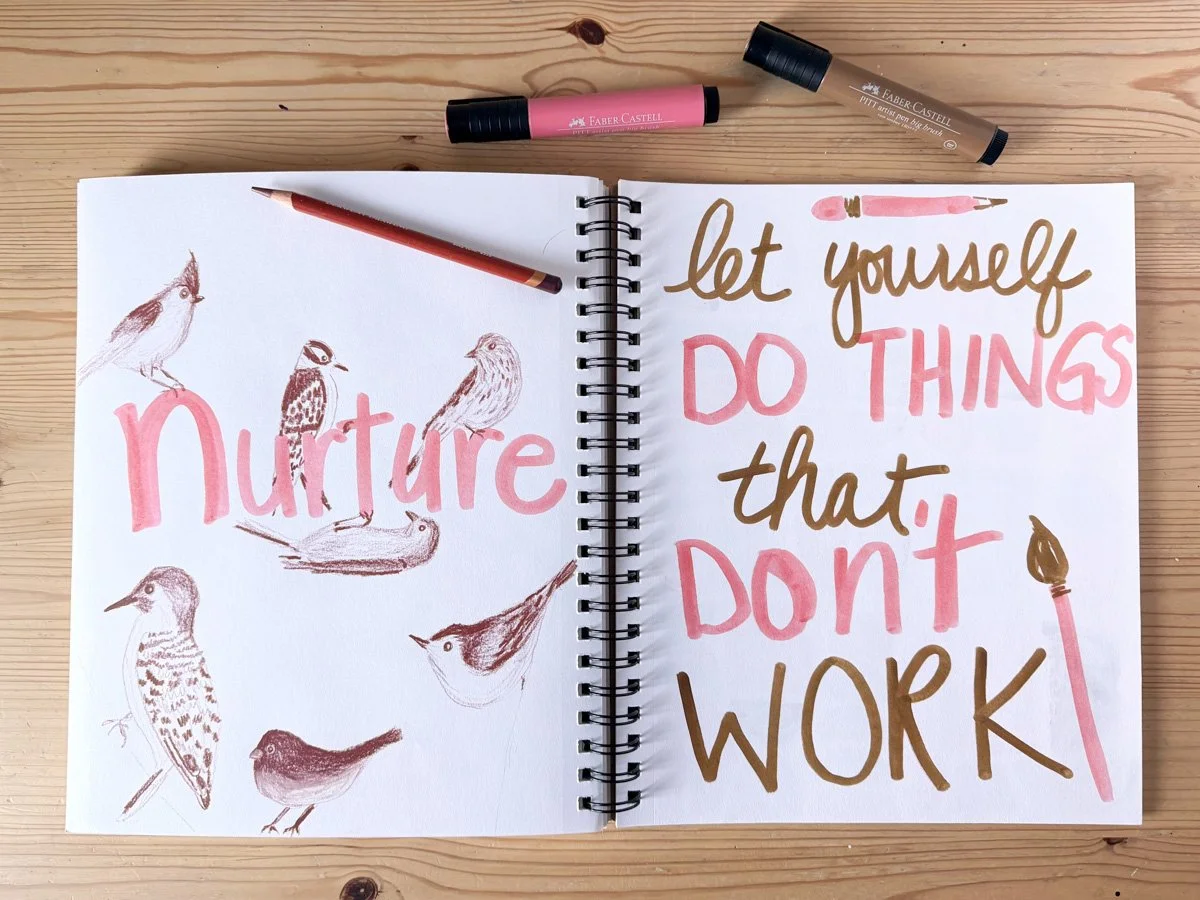
The first notebooks I fell in love with scribbling in were journals. For a long time, I kept my journaling practice and my sketchbook practice separate. Over the last couple of years, I’ve been journaling in my sketchbooks more and more, digging deep into thoughts about my process. In 2024 I started a studio journal, fully merging sketchbook and journal. I use it to work out ideas, to plan future work, to dream and imagine. This practice has spilled over into some of my other sketchbooks, too. It feels good. And it feels good to embrace doing things my own way in other areas of my life, too.
As a gardener, an artist and a lifelong journal keeper, you would think keeping a garden journal would be easy for me, but I’ve never been good at it. Part of it is that when I’m gardening, I’m too busy digging in the dirt to spend much time writing things down. And maybe it’s like with my sketchbooks and journals: gardening and art, although overlapping creatively, were separate acts for me. I also think that, like when I started working in sketchbooks, I had a skewed idea of what a garden journal is “supposed” to be: beautiful and polished.
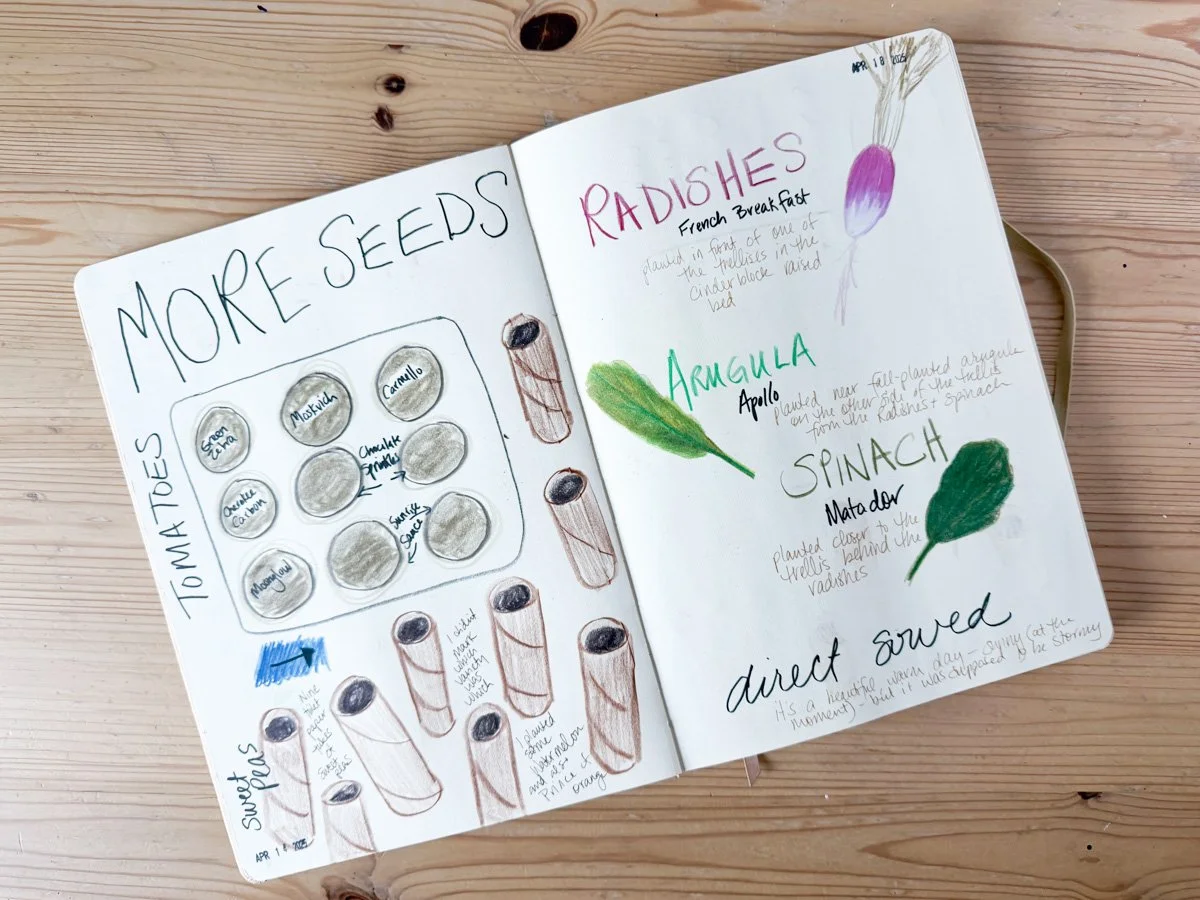
Last March I bought a sketchbook to use as my garden journal and began working in it with no expectations about what it needed to look like. I wanted to keep track of what I planted when (and where – something I am not always good at remembering). I drew diagrams of seedling trays. I documented successes and failures. I wrote lists of ideas and projects. I pondered changes to make to my tiny backyard garden. I glued information and photographs from seed packets and catalogs and inspiring photos from magazines. I did quick, playful sketches. Then, when we started moving, I used it to help me figure out how to straddle gardening in a space that would soon no longer be mine while transitioning to our new home in the country. And now I’m using it to plan the beginnings of my new garden. I’m loving it.
As you embark on this new year, I hope you can tap into the rhythm of the seasons, the rhythm of your seasons. Whether you’re striving to be more analog or dreaming of tackling a new project, trust yourself. Like the plants growing in my sunroom windows, don’t be intimidated by the frosty world outside. Remember that spring is coming and embrace your own pace. And if you, like some of plants, need deep rest, allow yourself the rest you need.